
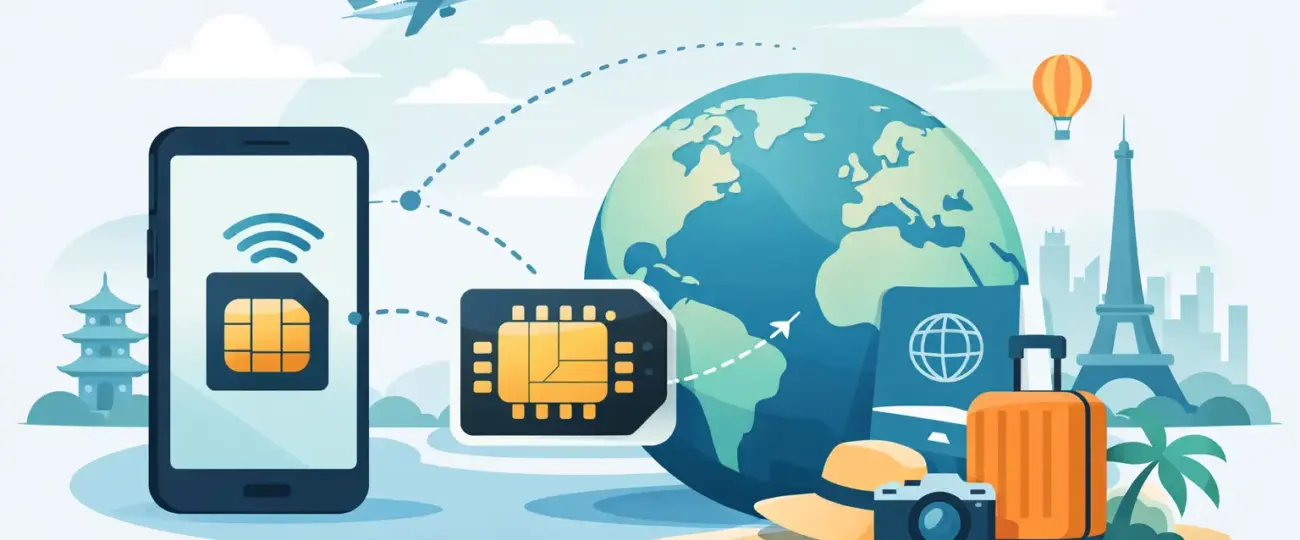


You land, switch off airplane mode, and need data right away – for rides, maps, messages, or a work call. That is exactly where the question what is a travel eSIM stops being technical and starts being practical.
A travel eSIM is a digital SIM that lets you activate a mobile data plan on your phone without inserting a physical SIM card. Instead of hunting for a local SIM at the airport or paying high roaming rates through your home carrier, you buy a plan online, install it on a compatible device, and connect when your trip starts.
For most travelers, the appeal is simple. You keep your trip moving. No store visits, no tiny plastic card to swap, and no guessing what your roaming bill will look like later.
An eSIM is an embedded SIM built into your device. It does the same basic job as a physical SIM – it identifies your device on a mobile network – but it works digitally.
A travel eSIM is that same technology packaged for international use. Instead of tying you to one local carrier at home, it gives you a mobile data plan designed for travel in a specific country, a region, or multiple countries.
That is why people often choose one before a trip. You can set it up in advance, arrive with data ready, and avoid the usual scramble for connectivity after landing.
The process is usually straightforward. You choose a destination and data plan, receive installation details, and add the eSIM profile to your phone. Many providers use a QR code for setup, though some also support manual entry.
Once installed, the eSIM sits on your device like a digital line. Depending on the plan, it activates immediately or when you arrive in the destination country. Your phone then connects to a supported local network, so you can use mobile data abroad without replacing your main physical SIM.
This matters if you want flexibility. Many newer phones support dual SIM use, which means you can keep your regular number active for calls or texts while using a travel eSIM for data.
Traditional roaming is easy in one sense – you do nothing and your phone keeps working. The problem is cost. Some home carriers offer decent travel passes, but many travelers still end up paying more than expected, especially on longer trips or multi-country itineraries.
A travel eSIM gives you more control. You choose the plan size, destination, and validity before you go. That makes it easier to match the purchase to your trip rather than accept whatever your home carrier charges.
There is also a convenience factor. Buying a local SIM can be cheaper in some places, but it often means finding a store, showing ID, dealing with language barriers, and physically swapping cards. If you are tired after a long flight, that friction feels bigger than it sounds.
Most people use a travel eSIM for the basics that suddenly feel urgent the moment they land. Maps, messaging apps, email, ride-share apps, translation tools, boarding passes, and banking alerts all depend on data.
It is also useful for travelers who move fast. If you are visiting several countries in one trip, a regional or global travel eSIM can save you from buying a new SIM every time you cross a border.
For business travelers and remote workers, the benefit is even clearer. Reliable data means you can answer messages, join meetings, tether to a laptop if needed, and stay reachable without relying on hotel or airport Wi-Fi.
A physical SIM still works well, and in some cases it may be the better fit. If your phone does not support eSIM, the choice is made for you. In a few destinations, local physical SIM plans may also offer very aggressive pricing for heavy long-term usage.
But for short trips and convenience-first travel, eSIM usually wins. Setup happens online, there is nothing to insert, and you can often install the plan before departure. That takes away one of the most annoying parts of international travel.
There is a smaller risk factor too. When you remove your home SIM, there is always a chance of misplacing it. With eSIM, your regular setup stays in place.
If you want data as soon as you arrive, a travel eSIM is usually a strong option. It works especially well for tourists, frequent flyers, business travelers, digital nomads, and anyone visiting more than one country on the same trip.
It is also a good fit if you want to keep your home number while using lower-cost travel data. That dual-SIM flexibility is one of the biggest practical advantages.
On the other hand, if you barely use mobile data, stay in one place for a long time, or have an unusually good international plan from your home carrier, the savings may be smaller. This is one of those cases where it depends on your usage, destination, and travel style.
Before you buy a travel eSIM, make sure your phone is eSIM compatible and carrier-unlocked. Those two details matter more than anything else. A locked phone may not let you add a travel plan from another provider.
You should also check whether the plan is data-only or includes calls and texts. Many travel eSIM products focus on mobile data, which works perfectly for messaging apps, navigation, and internet use, but not always for traditional voice service.
It also helps to look at the plan validity period and coverage area. A country-specific plan may be ideal for a single destination, while a regional option makes more sense if your itinerary includes several stops.
For first-time users, this is usually the part that sounds harder than it is. In practice, setup often takes just a few minutes.
You buy the plan, scan a QR code, follow the prompts on your phone, and label the new line if you want to keep things organized. Then you choose how your phone should use it – for mobile data, for calls, or alongside your main line.
Some travelers install the eSIM before departure and activate it once they land. That is often the easiest approach because you can handle setup while you still have a stable connection at home.
Providers that keep the process simple, with clear instructions and responsive support, tend to remove most of the friction for new users. That is a big reason travelers choose digital-first options like eSimple Pro.
One common question is whether a travel eSIM changes your phone number. Usually, if the eSIM is data-only, it does not replace your regular number. You can often keep your primary line active and use the travel eSIM just for data.
Another concern is network quality. A travel eSIM does not create its own towers – it connects through local carrier partners in the destination. That means performance depends on the plan and the local network coverage, just as it would with any mobile service.
People also ask if eSIM is only for tech-savvy travelers. Not really. If you can install an app or connect to Wi-Fi, you can usually set up an eSIM. The better the instructions, the easier the experience.
For many travelers, yes. The value comes from a mix of convenience, cost control, and speed. You buy before the trip, install in advance, and land with data ready to go.
It may not be the absolute cheapest option in every destination, every time. Local SIMs can still make sense for long stays, and roaming can be fine for very short trips if your home plan is generous. But travel eSIMs hit a sweet spot for people who want fewer steps and fewer surprises.
If your priority is staying connected without standing in line, swapping cards, or stressing about roaming fees, a travel eSIM is one of the simplest travel upgrades you can make.
The best travel tools are the ones you barely have to think about. Once your data works the moment you arrive, it is hard to go back to the old way.
 North eSIM
Price range: 1.78 € through 56.45 €
North eSIM
Price range: 1.78 € through 56.45 €
 eSim Bahrain
Price range: 1.75 € through 55.43 €
eSim Bahrain
Price range: 1.75 € through 55.43 €
 eSim Bahamas
Price range: 5.80 € through 183.93 €
eSim Bahamas
Price range: 5.80 € through 183.93 €
 eSim Azerbaijan
Price range: 1.75 € through 60.28 €
eSim Azerbaijan
Price range: 1.75 € through 60.28 €
 eSim Australia
Price range: 1.25 € through 65.98 €
eSim Australia
Price range: 1.25 € through 65.98 €
© 2026 Esimple. All rights reserved by Cubixsol

 Written by