
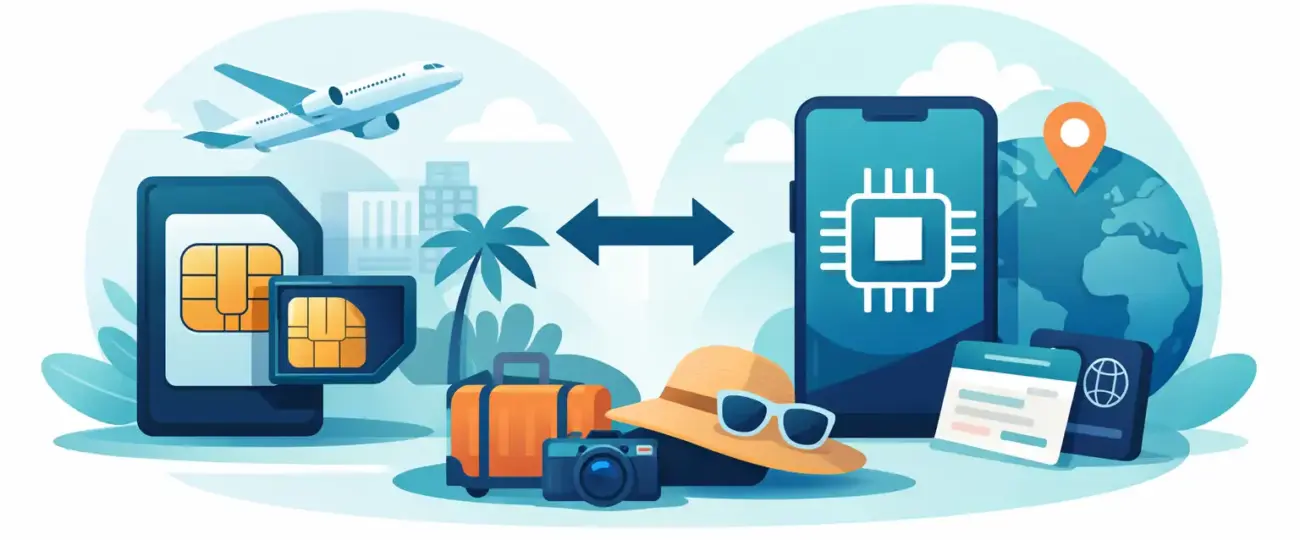


You land after a long flight, switch off airplane mode, and need data right away – for rideshare, hotel check-in, maps, and messages. That is exactly when the question of סים מקומי או eSIM stops being theoretical and becomes a practical travel decision.
For some trips, a local SIM still makes sense. But for many travelers, especially anyone who values speed and less friction, eSIM is the easier choice. The right answer depends on where you are going, how long you are staying, whether your phone supports eSIM, and how much hassle you are willing to deal with after landing.
Both options solve the same problem. You want mobile data abroad without paying expensive roaming fees to your home carrier. The difference is how you get connected.
A local SIM is a physical card you buy in your destination. You remove your current SIM, insert the new one, and use that carrier’s network. In some countries, this is simple. In others, it means finding a store, waiting in line, showing ID, dealing with language gaps, and figuring out which plan is actually a good deal.
An eSIM is digital. You buy the plan online, install it on a compatible phone, and activate it without swapping anything physically. For travelers, that changes the timing of the whole process. Instead of solving connectivity after arrival, you can set it up before departure and be ready the moment you land.
That convenience is the main reason eSIM has become the default choice for many frequent travelers, digital nomads, and business travelers. It removes the airport-store scramble.
A local SIM is not outdated. In a few situations, it can still be the better fit.
If you are staying in one country for a long period, a local carrier may offer larger data allowances or better long-term pricing than short-term travel plans. This matters most for students, temporary workers, or anyone spending several weeks or months in one place.
It can also be useful if you need a local phone number for domestic calls, local banking, deliveries, or service registrations. Some travel eSIM plans focus on data rather than voice and SMS, so that distinction matters if your trip depends on local number access.
There is also a device issue. Not every phone supports eSIM, and some carrier-locked phones limit what you can use abroad. If your device is not eSIM-compatible or not unlocked, a local SIM may be your only realistic option.
Still, even when local SIM pricing looks attractive, there is a trade-off. The advertised price is only part of the story. Time spent finding a store, understanding plan terms, registering the SIM, and replacing your usual card has a cost too.
For vacations, business trips, city breaks, and multi-country travel, eSIM usually fits how people actually move.
The biggest advantage is speed. You can buy, install, and prepare your plan before departure. Once you arrive, you connect without hunting for Wi-Fi or a mobile shop. That is especially useful after late-night arrivals, tight layovers, or landing in airports where carrier kiosks are closed or overpriced.
The second advantage is convenience. You keep your physical SIM in your phone, which means you avoid losing it, damaging it, or struggling to reinsert it later. If your device supports dual SIM functionality, you can often keep your home line active for calls or authentication while using eSIM for travel data.
The third advantage is flexibility. If your trip includes multiple countries, a regional or global eSIM can be much simpler than buying a new local SIM in every destination. One setup can cover the whole route. That is a major benefit for travelers moving quickly between countries.
Many travelers compare only the upfront price and assume local SIM always costs less. Sometimes that is true. Often, it is only partly true.
A local SIM may have a lower raw price for a large bundle, but you may also pay with time, inconvenience, or limited plan clarity. Some plans are great for residents but confusing for visitors. Others include top-up rules, activation steps, or app requirements that are easy to miss when you are tired and just arrived.
An eSIM plan may look slightly more expensive on paper, but the overall value can be better if it saves you from roaming charges, store visits, physical SIM swaps, and connection delays. For many travelers, especially short-term ones, paying a little more for a cleaner experience is worth it.
The smartest comparison is this: what do you actually need for this trip? If you need 5 to 10 GB for maps, messaging, email, and light streaming over one week, a travel eSIM is often the most efficient option. If you need very heavy data use over six weeks in one country, a local SIM might come out ahead.
This is where broad assumptions can lead travelers in the wrong direction. A local SIM is not automatically faster, and an eSIM is not automatically weaker. Performance depends on the network partner, your destination, local congestion, and the specific plan you buy.
A good travel eSIM uses established local network infrastructure, which means performance can be very strong. In practice, many travelers notice little to no difference for everyday use like navigation, browsing, messaging, video calls, and social apps.
What matters more is checking destination coverage, data allowance, speed policy, and whether the plan is built for one country or several. If you are traveling across borders, the best-performing option is often the one designed for that route rather than the cheapest single-country SIM you find at the first airport kiosk.
Setup is where the difference between סים מקומי או eSIM becomes obvious.
With a local SIM, setup starts after you arrive. You need to buy it, activate it, insert it, and test it. If something goes wrong, you troubleshoot in a new place, possibly in a different language, often while relying on weak airport Wi-Fi.
With eSIM, setup is usually handled before the trip. You purchase online, scan a QR code or follow install instructions, and keep the plan ready until arrival. That changes the first hour of your trip. Instead of solving a connectivity problem, you simply start using your phone.
That is one reason services like eSimple Pro appeal to travelers who want fewer moving parts. The simpler the setup, the less likely your trip begins with unnecessary friction.
If you are taking a short vacation, hopping across several countries, traveling for work, or arriving on a tight schedule, eSIM is usually the better choice. It is faster to set up, easier to manage, and better aligned with how modern travel works.
If you are staying in one country for an extended period, need a local number, or use a phone without eSIM support, a local SIM may be the smarter route. It can offer strong value if you have time to sort it out and your trip is stable enough that one domestic carrier plan covers everything you need.
For most travelers, the deciding questions are simple. Do you want connectivity before you land or after? Do you want to swap cards or keep your current setup intact? Are you visiting one country slowly or several countries quickly?
Before choosing, check three things: whether your phone is unlocked, whether it supports eSIM, and what kind of trip you are taking. Those three details usually make the answer clear.
If your priority is convenience, instant activation, and less airport hassle, eSIM is hard to beat. If your priority is maximum local value for a longer stay and you do not mind a bit of setup work, a local SIM can still be a good option.
The best travel connectivity choice is the one that fits the trip you are actually taking, not the one that looks cheapest in a vacuum. When your phone works the moment you need it, everything else on the trip gets easier.
 North eSIM
Price range: 1.78 € through 56.45 €
North eSIM
Price range: 1.78 € through 56.45 €
 eSim Bahrain
Price range: 1.75 € through 55.43 €
eSim Bahrain
Price range: 1.75 € through 55.43 €
 eSim Bahamas
Price range: 5.80 € through 183.93 €
eSim Bahamas
Price range: 5.80 € through 183.93 €
 eSim Azerbaijan
Price range: 1.75 € through 60.28 €
eSim Azerbaijan
Price range: 1.75 € through 60.28 €
 eSim Australia
Price range: 1.25 € through 65.98 €
eSim Australia
Price range: 1.25 € through 65.98 €
© 2026 Esimple. All rights reserved by Cubixsol

 Written by