


You land after a long flight, need to order a ride, and see a message that your hotel has changed check-in instructions. That is the moment the travel eSIM vs pocket WiFi decision stops being technical. You need data that works now, without hunting for a rental counter, charging another device, or risking expensive roaming charges.
Both options can get you online abroad. The better choice depends on your phone, how many people are traveling with you, where you are going, and how much simplicity matters. For most travelers with an unlocked, eSIM-compatible phone, a travel eSIM is the lighter and faster option. Pocket WiFi can still make sense in a few specific situations.
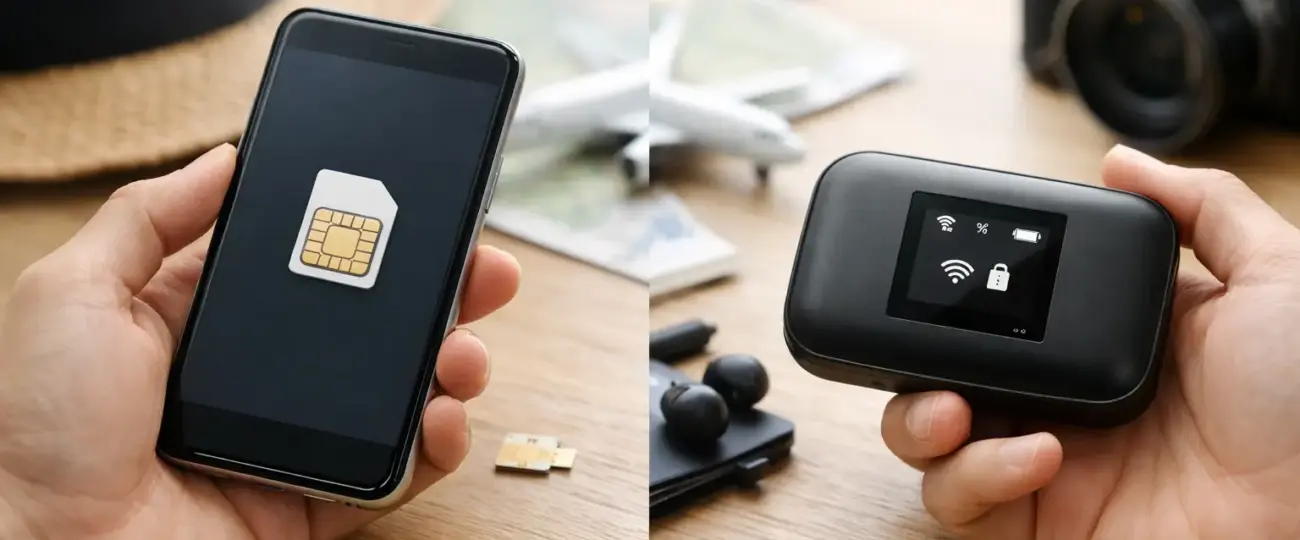
A travel eSIM is a digital SIM installed directly on your compatible phone. You purchase a plan online, scan a QR code or follow the installation steps, and connect when you arrive. There is no physical card to insert and no separate device to carry.
Pocket WiFi, also called a mobile hotspot, is a small rented or purchased device that connects to local mobile networks and shares that connection over Wi-Fi. Your phone, laptop, tablet, or other devices connect to it like they would to a home router.
If you are traveling alone or with one other person and primarily need data on your phone, an eSIM is usually the more convenient option. If several people need to connect multiple devices at once, especially devices without eSIM support, a pocket WiFi unit may be useful. The trade-off is that convenience often shifts in favor of the eSIM, while device sharing can favor pocket WiFi.
The setup experience is one of the biggest differences.
With an eSIM, you can choose a destination plan before departure and install it while you still have reliable Wi-Fi. When you arrive, turn on the eSIM line and data roaming for that eSIM if the installation instructions require it. Your phone connects to a supported local network without a store visit or SIM swap.
This is especially helpful for late-night arrivals, short layovers, and trips where you need maps or ride-share access as soon as the plane doors open. You also keep your physical SIM in your phone, which can be useful for receiving calls or verification texts on your usual number, depending on your device settings and carrier.
Pocket WiFi requires more logistics. You may need to reserve the device, choose airport or hotel delivery, pick it up, and return it by a deadline. Some providers include return packaging, while others require a drop-off location. Missing the return date or losing the device can lead to additional fees.
Neither option is difficult, but they solve the problem differently. An eSIM removes the rental hardware process. Pocket WiFi adds a device and a handoff process to your travel checklist.
Pocket WiFi can look affordable at first, particularly when the rental cost is shared between several travelers. But the advertised daily rate is not always the final price. Check for delivery fees, insurance, activation fees, return shipping, deposit requirements, and charges for loss or damage. Also confirm whether the plan has a high-speed data limit before speeds are reduced.
Travel eSIM plans are generally easier to compare because you select a data amount, coverage area, and validity period upfront. A country plan can be a good fit for a single-destination trip, while a regional or global plan can reduce the need to buy new data every time you cross a border. If you use more data than expected, many eSIM plans allow top-ups without buying another physical product.
Your actual cost depends on usage. A traveler who only needs maps, messages, transportation apps, and occasional browsing may need far less data than someone uploading video, joining video calls, or tethering a laptop every day. Avoid paying for unlimited data automatically if a smaller fixed-data plan matches your trip better. At the same time, do not choose the lowest data allowance if running out would leave you without essential access.
A pocket WiFi device needs its own battery, cable, and a safe place in your bag. If it runs out of power, every device connected to it can lose access. It also has to stay close to you. Walk away from the person carrying the hotspot at a museum, train station, or shopping district, and your connection may disappear.
An eSIM uses the phone already in your hand. There is no separate hotspot to charge, return, or remember. That matters on busy travel days when your phone is already your boarding pass, camera, map, wallet, translator, and communication tool.
There is one important exception. Pocket WiFi can be practical for a family or group that stays together most of the time. One device may connect several phones and tablets, which can simplify data access for children or travelers with older phones. Just remember that shared use means shared speed and shared battery life.
Neither an eSIM nor pocket WiFi guarantees identical performance everywhere. Both depend on local network coverage, network congestion, plan terms, and the device you are using. A plan with wide destination coverage is useful, but a remote mountain town, underground subway platform, or crowded stadium can still have weaker service than a city center.
Before buying, confirm that your destination is covered and review the plan’s validity period and data allowance. For multi-country travel, verify every country on your itinerary, including stopovers where you may want data. A regional plan can be more convenient than managing separate country plans, but only if it includes the places you will actually visit.
Phone compatibility matters for eSIMs. Your device must support eSIM technology and usually needs to be unlocked. Most newer flagship phones do, but not every model or regional version is compatible. Check your phone settings or manufacturer details before purchasing. If your phone is locked to a carrier or does not support eSIM, pocket WiFi may be a workable alternative.
Speed is also worth considering. A pocket WiFi unit may support local 4G or 5G, but its connection is shared across every device using it. An eSIM provides data directly to your phone, which often feels more responsive for navigation, messaging, and everyday app use. The real result will vary by local network and plan.
Choose a travel eSIM when you want to arrive connected without arranging a hardware pickup. It is a strong fit for solo travelers, couples, business travelers, digital nomads, and anyone moving between countries. It also works well when you want to keep your primary SIM in place and avoid carrying another battery-powered device.
An eSIM is particularly useful for fast-moving itineraries. If you are flying into Paris, taking a train to Brussels, and continuing to Amsterdam, a regional plan can keep your setup simple. Instead of replacing SIM cards or collecting a new hotspot, you manage your data from your phone.
eSimple Pro plans are designed for this kind of travel: select a country, regional, or global plan, install it before you leave, and activate when you reach your destination. The goal is straightforward data access without a physical SIM swap or surprise roaming bill.
Pocket WiFi is worth considering when several people need data on multiple devices and will stay close together. It can also help if you are traveling with a laptop, tablet, or older phone that cannot use eSIM, and you do not want to rely on hotel Wi-Fi.
It may be a sensible backup for a work team sharing a connection at an event, although heavy video calls and file transfers can consume shared data quickly. Read the provider’s fair-use policy carefully. “Unlimited” does not always mean unlimited high-speed data all day.
For individual travel, pocket WiFi becomes less appealing if you expect to split up, move around independently, or travel light. The savings are rarely worth the extra device if you are the only person using it.
Start with three questions: Is your phone unlocked and eSIM-compatible? How many people and devices need internet access? Are you visiting one country or moving through several?
If your phone supports eSIM and your priority is immediate, personal mobile data, choose an eSIM plan that matches your destination and expected usage. Install it before departure, save the setup instructions, and keep your primary SIM settings clear so you know which line handles data.
If your group truly needs one shared connection, compare the full pocket WiFi rental cost, pickup process, battery life, and return terms before committing. A good travel connection should remove friction, not create another task to manage when you are trying to enjoy the trip.
 North eSIM
Price range: 1.78 € through 56.45 €
North eSIM
Price range: 1.78 € through 56.45 €
 eSim Bahrain
Price range: 1.75 € through 55.43 €
eSim Bahrain
Price range: 1.75 € through 55.43 €
 eSim Bahamas
Price range: 5.80 € through 183.93 €
eSim Bahamas
Price range: 5.80 € through 183.93 €
 eSim Azerbaijan
Price range: 1.75 € through 60.28 €
eSim Azerbaijan
Price range: 1.75 € through 60.28 €
 eSim Australia
Price range: 1.25 € through 65.98 €
eSim Australia
Price range: 1.25 € through 65.98 €
© 2026 Esimple. All rights reserved by Cubixsol

 Written by