
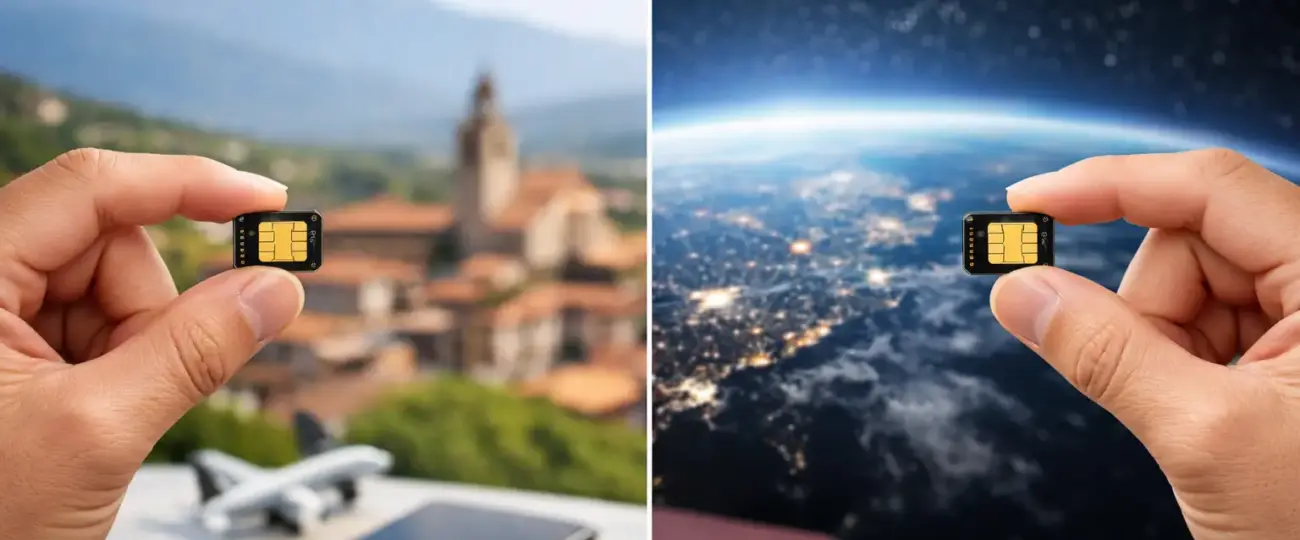


Landing in Europe for a two-week trip is not the time to discover your data plan ends at the border. The regional eSIM vs global eSIM decision comes down to one practical question: where are you actually going, and how much flexibility do you need once the itinerary changes?
Both options let you buy data before departure, install a digital SIM with a QR code, and avoid swapping your physical SIM at the airport. The right choice can keep navigation, rideshares, messages, work apps, and travel bookings available from arrival onward. The wrong one can mean paying for coverage you never use or needing another plan halfway through your trip.
A regional eSIM covers a defined group of countries. Examples may include Europe, Asia, North America, Latin America, the Caribbean, or the Middle East and Africa. You use one plan across the destinations included in that region, rather than buying a separate plan for each country.
A global eSIM is built for wider travel. It can provide coverage across a large number of countries and regions under one plan. This is useful when your route crosses continents or when you travel often and do not want to shop for a new data plan for every trip.
The difference is not just the number of destinations. Regional plans are usually more focused, while global plans prioritize reach and convenience. Neither is automatically better. It depends on your route, data needs, trip length, and how likely you are to make last-minute changes.
A regional eSIM is often the most sensible option when all or most of your destinations sit within the same part of the world. Think of a vacation that moves from France to Italy and Greece, a Southeast Asia backpacking route, or a business trip through the US, Canada, and Mexico.
Instead of installing a new country plan at every stop, you install one regional eSIM before departure. Once the plan is active, your phone connects to supported local networks as you enter each included country. That means less time searching for Wi-Fi, comparing plans, or dealing with physical SIM cards during a transfer day.
Regional plans can also be better value than global plans for travelers staying inside one coverage area. Since the plan is designed for a narrower footprint, it may offer more data or a lower price for that specific route. It is a strong fit for travelers who have a clear itinerary and want simple coverage without paying for worldwide access.
That said, check the covered-country list before buying. A plan labeled “Europe” may include dozens of destinations but not every country on the continent. If your itinerary includes a smaller destination, a territory, or a stop outside the main region, confirm it is supported before you rely on the plan.
Choose a regional eSIM when you are visiting two or more countries in the same region, when your route is mostly set, and when you want the best balance of coverage and cost. It is particularly useful for rail trips, cruises with regional ports, road trips, and multi-city business travel.
If you are only visiting one country, compare the regional option with a country-specific eSIM as well. A local plan may be the most cost-effective choice for a longer stay in one destination, especially if you expect to use a lot of data.
A global eSIM is designed for travelers whose route does not fit neatly into one region. For example, you might fly from the US to the UK for meetings, continue to the UAE, then add a few days in Singapore. Buying separate regional plans would work, but it adds more installs, more activation rules, and more plans to track.
With one global eSIM, you can keep a single travel data option ready across many destinations. This is valuable for frequent flyers, digital nomads, international consultants, flight crews, and travelers on open-ended trips. It is also useful when a missed connection, an unexpected layover, or a last-minute detour puts you somewhere that was not on the original plan.
The trade-off is price and data allowance. Because global coverage is broader, the cost per gigabyte can be higher than a country or regional plan. Global plans may also have fewer high-data options than plans designed for a single market. If you will spend three weeks in one country streaming video and tethering a laptop, a global plan may not be the most economical primary option.
A global eSIM is a practical choice when you visit countries in multiple regions, travel frequently throughout the year, or need backup data that works across a wide range of destinations. It reduces planning effort and gives you more confidence when your schedule is not fixed.
For many business travelers, that convenience is worth the premium. Being able to open email, book a car, join a video call, or contact a client shortly after landing can matter more than finding the lowest possible data rate.
A lower-priced plan is not a better deal if it does not work where you need it. Before choosing between regional and global coverage, review your full itinerary, including connections, cruise ports, side trips, and border crossings.
Then look at the plan details. Confirm each destination is included, check how long the plan remains valid, and make sure the data allowance matches how you use your phone. Map apps, messaging, email, and ride apps use relatively little data. Video calls, social media uploads, cloud backups, hotspot use, and streaming can use much more.
Also check whether the plan supports 4G, 5G, or both in your destination. Network availability depends on local carrier coverage and your device, so speeds can vary by city and location. A plan that connects to more than one local network may give you more flexibility, but coverage terms should always guide the decision.
Before purchase, make sure your phone is eSIM-compatible and carrier-unlocked. Most newer smartphones support eSIM technology, but capabilities vary by model and market. If you want to keep receiving calls or texts on your home number, confirm your device supports dual SIM use and review your carrier’s roaming settings to avoid unwanted charges.
Install your eSIM while you have reliable Wi-Fi, ideally before you leave. You will usually receive a QR code or manual installation details after purchase. Add the eSIM to your phone, label it clearly, and set it as the mobile data line when you are ready to use it abroad.
Do not activate a plan too early if its validity begins at installation or first network connection. Each plan has its own activation policy. For plans that activate on arrival, you can complete the installation at home and let the eSIM connect when you reach a covered destination.
Keep your QR code and plan details available offline. A screenshot or saved email can help if you need to reinstall the eSIM or adjust settings while traveling. If you need more data later, choose a provider with clear top-up options rather than assuming every plan can be extended.
Start with your destination count. One country usually points to a country-specific plan. Several countries in one area usually point to a regional eSIM. Multiple regions, frequent international travel, or an unpredictable route often justify a global eSIM.
Next, consider your data habits. A traveler using maps and messaging may prioritize broad coverage and a smaller allowance. A remote worker who uses a hotspot may get better value from a regional plan with more data in the countries where they will spend the most time. Some travelers use a global eSIM for arrival-day and backup connectivity, then add a larger regional or local plan for a longer stay.
With eSimple Pro, travelers can select coverage based on the trip rather than forcing every itinerary into the same plan. Buy before you fly, install in minutes, and arrive ready to connect.
Your itinerary does not have to be perfect before you choose. Just make sure your eSIM matches the places you are most likely to go, leaves room for the unexpected, and gives you enough data to travel without hunting for a connection.
 North eSIM
Price range: 1.78 € through 56.45 €
North eSIM
Price range: 1.78 € through 56.45 €
 eSim Bahrain
Price range: 1.75 € through 55.43 €
eSim Bahrain
Price range: 1.75 € through 55.43 €
 eSim Bahamas
Price range: 5.80 € through 183.93 €
eSim Bahamas
Price range: 5.80 € through 183.93 €
 eSim Azerbaijan
Price range: 1.75 € through 60.28 €
eSim Azerbaijan
Price range: 1.75 € through 60.28 €
 eSim Australia
Price range: 1.25 € through 65.98 €
eSim Australia
Price range: 1.25 € through 65.98 €
© 2026 Esimple. All rights reserved by Cubixsol

 Written by