
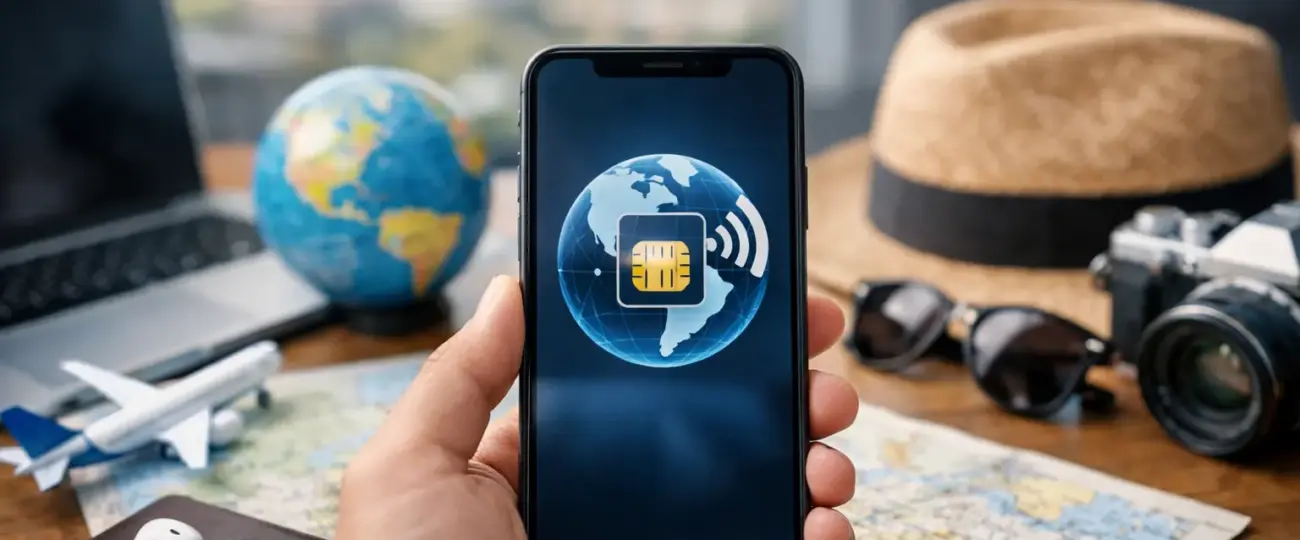


Landing in a new country with no map, no ride app, and no way to message your hotel is a bad start to any trip. This global eSIM data plan review focuses on the details that matter once you are actually traveling: where your data works, how much you need, what affects speed, and whether one plan is better than buying separate eSIMs along the way.
A global eSIM can be the simplest option for travelers crossing borders quickly. Instead of finding a mobile shop in every destination or risking expensive carrier roaming, you install a digital plan before departure and connect when you arrive. But convenience only delivers value when the plan matches your route and how you use data.
A global eSIM data plan provides mobile data across a wide list of countries under one package. You buy it online, receive installation instructions or a QR code, add the eSIM to a compatible phone, and activate it according to the plan terms. There is no physical SIM card to remove, store, or replace.
The biggest advantage is continuity. If your trip includes New York to London, then Paris, Dubai, and Singapore, a global plan can keep your phone ready as you move between those destinations. You do not need to research a new local carrier every few days. For business travelers, cruise extensions, gap-year trips, and multi-country vacations, that can remove a lot of friction.
Most travel eSIMs are data-only. Calls and texts through your usual mobile number may not be included, but you can use apps such as FaceTime, WhatsApp, Google Meet, and messaging platforms over data. If keeping your home number available matters, use dual-SIM settings: keep your primary line on for calls or verification texts while assigning mobile data to the travel eSIM. Check your home carrier’s roaming settings first so your primary line does not use paid data in the background.
A global plan is not automatically the best plan for every itinerary. It is built for flexibility, and flexibility can cost more per gigabyte than a country-specific package. If you are spending two weeks in one country, a local eSIM may offer more data for the same budget. If you are visiting several countries, the time saved by using one plan may be worth far more than a small price difference.
Coverage is the first thing to check. A plan can be called global while covering a defined list of destinations rather than every country on the map. Review your complete itinerary, including layovers, island stops, and side trips. Also check whether the plan works in every destination you expect to visit, not just the major cities.
Network performance is the second trade-off. Travel eSIM providers connect through local partner networks, so service quality depends partly on the country, the available network, your device, and where you are standing. You may see 5G in one city and 4G in another. That is normal. A reliable 4G connection is more than enough for navigation, ride sharing, email, social media, and video calls.
The third consideration is plan duration. Data plans commonly run for a set number of days, such as 7, 15, or 30 days. The validity period may begin on installation, on first connection to a supported network, or on a specific activation date. This detail affects when you should install your eSIM. Installing it before you leave is often smart, but activating data too early is not.
Finally, understand what happens after you use your data allowance. Some plans stop working until you top up. Others may continue at reduced speeds. Neither approach is inherently better. A traveler relying on maps and work calls may prefer a plan with easy top-up options, while a light user may simply choose a larger allowance upfront and avoid monitoring usage.
Data needs are personal, but your travel habits give a good estimate. Navigation, messaging, browsing, email, and occasional social posts use relatively modest amounts of data. Constant video streaming, hotspot use, cloud backups, and uploading high-resolution video use much more.
For a short trip where you mostly need directions, reservations, and messaging, 1 GB to 3 GB can be enough. For a week of regular browsing, social media, ride apps, and some video calls, 5 GB to 10 GB is a more comfortable range. Remote workers and heavy content users should consider 10 GB or more, especially if they expect to tether a laptop.
Do not choose only by the largest number of gigabytes. A 20 GB plan that expires before the end of your trip is less useful than a 10 GB plan with the right validity period and a simple top-up path. It also helps to download maps, playlists, language packs, and entertainment before departure. Those small steps reduce pressure on your travel data when you need it most.
The eSIM process is designed to be fast. With a provider such as eSimple Pro, the basic flow is buy, scan, and connect. Still, a few minutes of preparation can prevent avoidable issues at the airport.
Before purchase, make sure your phone supports eSIM and is unlocked for use with other carriers. Most newer iPhones, Google Pixel phones, and many Samsung Galaxy models support eSIM, but compatibility varies by device model and region. If your phone is carrier-locked, it may not accept a travel eSIM.
Once you receive the eSIM, install it while you have stable Wi-Fi. Give the line a clear label such as “Travel Data” so you can recognize it in your phone settings. Keep it turned off until the plan’s activation guidance says to connect, if needed. When you arrive, turn on the eSIM line, select it for cellular data, enable data roaming for that eSIM if the instructions require it, and turn off data switching to your home line.
If the connection does not start right away, do not panic. Toggle airplane mode, restart the phone, confirm that cellular data is assigned to the eSIM, and check whether network selection should be automatic. Save your installation details and support instructions before you travel. Hotel Wi-Fi is useful, but it should not be your only backup plan.
The right global eSIM is the one that fits your route without making you pay for features you will not use. Compare plans based on practical travel conditions, not just a headline price.
Look closely at these four points:
Also consider whether you need a global, regional, or country plan. A traveler visiting Italy and Spain may find a Europe regional eSIM more targeted. Someone traveling through several continents may benefit from global coverage. For one destination, a country-specific plan can often provide the best data value.
Global eSIM plans are especially useful when your itinerary is still moving. They work well for travelers with multiple countries, people taking an open-jaw flight, business travelers who may add a last-minute stop, and families who want a simple setup before leaving home.
They are less compelling when you are staying in one place for a long time and need large amounts of data every day. In that case, compare a local plan or a country eSIM. The best choice depends on coverage, duration, and your expected data use, not on whether a plan has the word “global” on it.
A good travel data plan should disappear into the background. Set it up before you leave, confirm your destinations are covered, and keep your phone ready for the moments that make travel easier: finding the right platform, calling a ride, sharing an arrival update, or changing plans without searching for a SIM card store.
 North eSIM
Price range: 1.78 € through 56.45 €
North eSIM
Price range: 1.78 € through 56.45 €
 eSim Bahrain
Price range: 1.75 € through 55.43 €
eSim Bahrain
Price range: 1.75 € through 55.43 €
 eSim Bahamas
Price range: 5.80 € through 183.93 €
eSim Bahamas
Price range: 5.80 € through 183.93 €
 eSim Azerbaijan
Price range: 1.75 € through 60.28 €
eSim Azerbaijan
Price range: 1.75 € through 60.28 €
 eSim Australia
Price range: 1.25 € through 65.98 €
eSim Australia
Price range: 1.25 € through 65.98 €
© 2026 Esimple. All rights reserved by Cubixsol

 Written by