
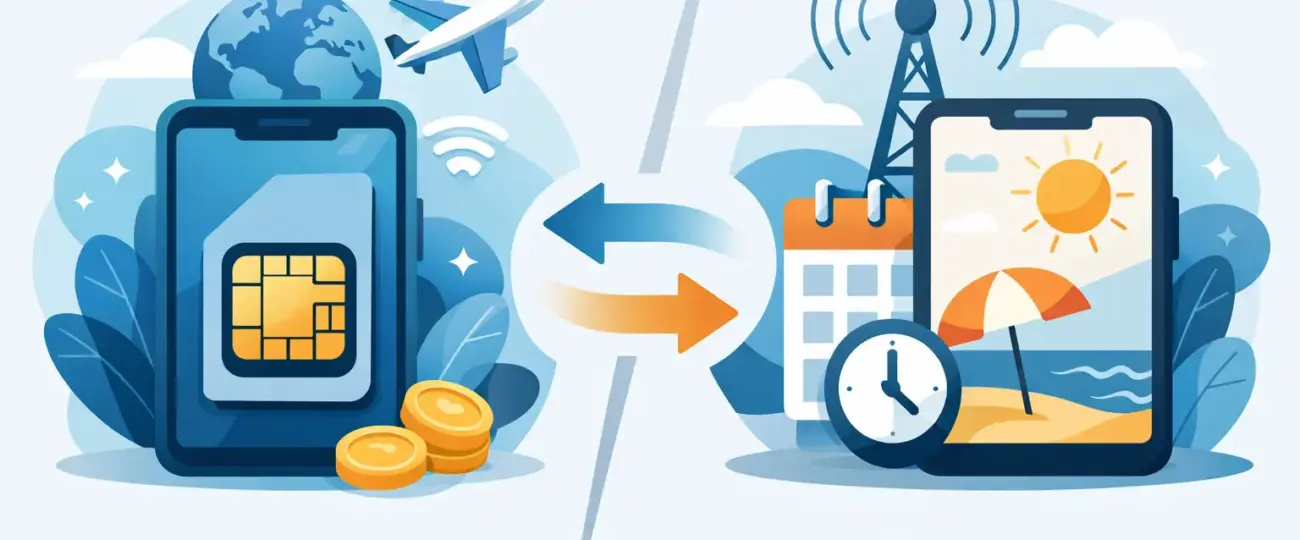


Land in a new country, turn off airplane mode, and the decision shows up fast: prepaid eSIM or carrier DayPass? For most travelers, this is really a choice between paying for convenience through your home carrier or setting up a separate travel data plan before you go. Both can work. The better option depends on how long you are away, how much data you use, and how much surprise billing you are willing to tolerate.
If you want the shortest answer, a carrier DayPass is usually the easiest fix for a short trip with light phone use. A prepaid eSIM usually gives you better value, more control, and fewer roaming surprises, especially for trips longer than a couple of days or itineraries that cross borders.
A carrier DayPass lets you use your domestic plan abroad for a daily fee. It feels familiar because your number, texts, and usual carrier settings stay in place. If you are away for a day or two and do not want to think about setup, that simplicity is the main selling point.
A prepaid eSIM works differently. You buy a travel data plan for your destination, install it digitally, and activate it on an eSIM-compatible phone. You keep your physical SIM in place if you want, which is useful for dual-SIM phones. In practice, that means you can use travel data without swapping cards at the airport or hunting for a local store after landing.
The difference becomes obvious once you look past the first ten minutes of convenience. A DayPass is priced per day, whether you use much data or not. A prepaid eSIM is priced by package, so you know the allowance and the cost up front. That structure matters if your trip lasts more than a weekend.
Travelers often choose DayPass because the daily fee looks manageable. Ten or twelve dollars a day may not sound dramatic when you are rushing through trip planning. Over a week, though, that can easily add up to $70 or more just to access the plan you already pay for at home.
That math gets harder to justify on longer trips. A 10-day vacation, a two-week work trip, or a multi-country itinerary can turn a DayPass into one of the most expensive parts of your phone use. And because the charge is tied to each day of use, quick check-ins, map lookups, and rideshare bookings can trigger a full day fee.
A prepaid eSIM is usually more predictable. You buy a set amount of data for a set destination and timeframe. If your usage is light, you can choose a smaller package. If you know you will be tethering, taking video calls, or using navigation constantly, you can choose a larger one. That flexibility is why many frequent travelers move away from roaming passes once they compare total trip cost rather than one day at a time.
That said, DayPass can still make financial sense for very short travel. If you are crossing into Canada for a day, taking a quick business trip, or only need your phone fully active for one or two days, paying the daily fee may be perfectly reasonable.
DayPass is convenient because it requires almost no planning. If your carrier offers it automatically, you may simply arrive and start using your phone. There is comfort in that, especially for travelers who do not want to learn anything new before departure.
But prepaid eSIM convenience shows up earlier. Instead of solving connectivity after landing, you handle it before the trip. You buy online, install the eSIM, and arrive with data ready to go. That means no airport kiosks, no language barrier at local carrier stores, and no waiting until hotel Wi-Fi is available just to get connected.
For many travelers, that is the better kind of convenience. The first hour in a new destination is when maps, messages, and transportation matter most. If your travel style involves moving fast, making connections, or arriving late at night, having data ready the moment you land is more useful than relying on roaming settings to sort themselves out.
Carrier DayPass sounds simple because it extends your home plan abroad, but performance still depends on roaming agreements in the country you are visiting. In some destinations, that works very well. In others, speeds may be deprioritized or coverage may feel less consistent than expected.
A prepaid eSIM typically connects through local partner networks in the destination you selected. That can be a real advantage when the plan is built specifically for travelers in that market. It often means better alignment with local coverage conditions and clearer plan terms.
There is still an it-depends factor here. Not all eSIM plans are equal, and not all DayPass roaming experiences are poor. If you are going to a major city for two days, either option may perform well enough. If you are traveling through several countries, taking trains across borders, or relying heavily on data in transit, a regional or global prepaid eSIM often makes the overall trip smoother.
One reason business travelers stick with DayPass is that they want everything to behave exactly as it does at home. Their primary number stays active for calls and texts, and they do not want to risk missing a bank alert, client call, or two-factor authentication message.
That is a real consideration, but it does not automatically rule out a prepaid eSIM. On many phones, you can keep your primary line active and use the eSIM for data. That setup gives you the benefit of cheaper travel data while preserving access to your regular number.
This is where a little phone literacy helps. If your device supports dual SIM and eSIM, you can often choose which line handles data and which line stays available for voice or texts. For travelers who want control without giving up their usual number, that is often the best middle ground.
This is where the gap gets wider.
A DayPass can feel manageable in one destination. Once your trip includes Paris, Rome, and Barcelona in the same week, daily roaming fees start stacking up fast. You are still paying by day, and the total cost keeps climbing even if your usage pattern does not change much.
A prepaid eSIM is often better suited to multi-country travel because regional plans are built for that exact use case. Instead of paying a daily fee each time you use data abroad, you can buy one plan that follows your trip across borders. That reduces both cost and friction.
For digital nomads, long vacations, and travelers building flexible itineraries, this is usually the tipping point. You want a setup that moves with you, not one that charges you repeatedly for the same basic access.
There are cases where DayPass is still the better option. If your trip is extremely short, you need full voice and text continuity with zero setup, and cost is not your main concern, DayPass does the job. It is also useful if your phone is not eSIM-compatible or if you are the kind of traveler who does not want to adjust any settings before departure.
It can also be a practical backup. Some travelers keep DayPass available in case they need immediate voice service, then use a prepaid eSIM for most of their data needs. That approach is not the cheapest, but it can be reassuring for high-stakes travel.
If you care about avoiding bill shock, controlling spend, and having data ready the moment you arrive, prepaid eSIM is usually the stronger option. It is especially well suited to trips longer than a few days, multi-country itineraries, and travelers who use maps, messaging apps, ride-hailing, social media, or hotspot data regularly.
It is also the cleaner solution for people who want to stay in control. You choose the plan, the coverage area, and the data amount before you travel. That clarity is a big reason more travelers now buy, scan, and connect instead of relying on carrier roaming fees after the fact.
For everyday travelers, the setup is no longer difficult. If your phone supports eSIM, the process is usually straightforward enough to handle in minutes. That is why brands like eSimple Pro have gained traction with travelers who want a simple self-service option instead of roaming guesswork.
So if you are still deciding between prepaid eSIM or carrier DayPass, ask yourself one practical question: do you want to pay for one day at a time, or do you want to choose your travel data on your terms before the trip even starts? For most travelers, the less stressful answer is also the one that costs less.
 North eSIM
Price range: 1.78 € through 56.45 €
North eSIM
Price range: 1.78 € through 56.45 €
 eSim Bahrain
Price range: 1.75 € through 55.43 €
eSim Bahrain
Price range: 1.75 € through 55.43 €
 eSim Bahamas
Price range: 5.80 € through 183.93 €
eSim Bahamas
Price range: 5.80 € through 183.93 €
 eSim Azerbaijan
Price range: 1.75 € through 60.28 €
eSim Azerbaijan
Price range: 1.75 € through 60.28 €
 eSim Australia
Price range: 1.25 € through 65.98 €
eSim Australia
Price range: 1.25 € through 65.98 €
© 2026 Esimple. All rights reserved by Cubixsol

 Written by