
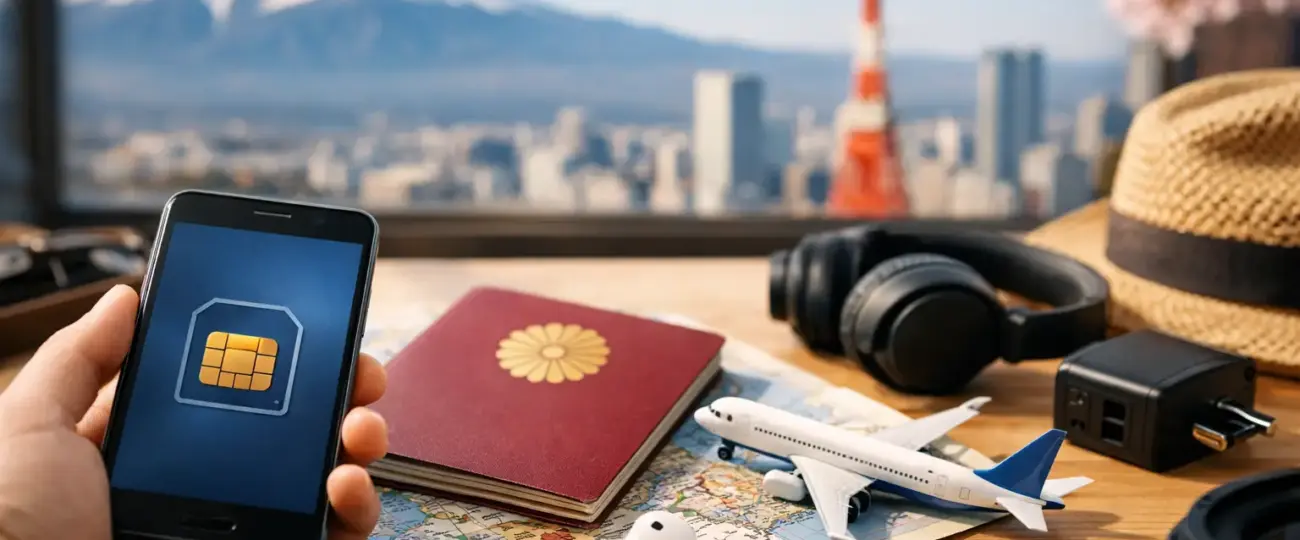


Landing in Japan with no data is a fast way to turn a simple arrival into a headache. You need maps for the train, messages for hotel check-in, and reliable service the moment you leave the airport. That is exactly why more travelers now choose esim ליפן instead of relying on roaming or trying to buy a local SIM after landing.
Japan is one of the easiest places to enjoy with solid mobile data and one of the most frustrating places to navigate without it. Stations are huge, transfers move quickly, and many travelers depend on translation, route planning, and app-based reservations throughout the day. If your phone is your trip planner, transit pass, and backup guide, your data setup matters more than most people expect.
For many US travelers, traditional roaming feels convenient right up until the bill arrives. Even when a carrier offers an international pass, the daily cost can add up quickly on a longer trip. Local SIM cards can be cheaper, but they come with their own friction – finding a shop, dealing with language barriers, swapping out your physical SIM, and keeping track of your main number.
An eSIM removes most of that hassle. You buy online before departure, install it in minutes, and your phone is ready to connect when you arrive. No store visit, no tiny SIM tray, no waiting in line after a long flight. For travelers going to Japan for a week, two weeks, or even a multi-stop Asia trip, that convenience is usually the deciding factor.
There is also the dual-SIM advantage. If your phone supports it, you can keep your regular number active for calls or authentication while using the eSIM for data in Japan. That is especially useful for banking texts, airline alerts, and messaging apps tied to your home number.
This is where travelers often either overbuy or cut it too close. Japan is data-friendly in the sense that you are likely to use your phone constantly. Between Google Maps, transit apps, restaurant searches, translation tools, rideshare alternatives, and photo uploads, daily usage adds up fast.
If you are a light user who mainly checks maps, messages, and email, 1GB per day can be enough. A more typical traveler will be more comfortable with 2GB per day or a moderate fixed-data plan for the full trip. If you plan to hotspot, stream video, post often, or work remotely, you should expect to need more.
The right choice depends on your travel style. A business traveler commuting between hotel and meetings may use less than a tourist bouncing across Tokyo, Kyoto, Osaka, and day-trip destinations. A solo traveler who leans heavily on navigation and translation may burn more data than a couple sharing one route plan on one device.
That is why flexibility matters. Plans with straightforward top-up options are often better than trying to predict every megabyte in advance.
Price matters, but it should not be the only filter. The cheapest plan is not always the best plan if setup is confusing, speeds are unstable, or support is hard to reach when something goes wrong.
Japan generally has strong mobile infrastructure, especially in major cities and along common travel routes. Still, plan quality can vary depending on the local network partnerships behind the eSIM. If your trip includes smaller towns, mountain areas, or multiple regions, broad coverage is worth paying attention to.
For most travelers, 4G is more than enough for maps, browsing, messaging, and video calls. 5G is a nice bonus if available, but it should not be the only reason to choose a plan. Reliability is usually more useful than chasing peak speed numbers.
Some plans activate as soon as installation is completed. Others activate when they first connect in Japan. That difference matters. If a plan starts counting down right after setup, installing too early can waste a day or two before your flight even takes off.
Always check the activation rule before you buy. If your service begins on arrival, you can install it ahead of time and travel with one less thing to worry about.
Not all unlimited plans are truly unlimited at full speed. Some providers reduce speed after a daily threshold. That is not necessarily a deal-breaker, but it should be clear before purchase. If your trip depends on steady performance for work or navigation, hidden slowdowns can become a real issue.
This is one of the biggest reasons travelers choose digital plans in the first place. The process should be simple: buy, scan a QR code, install, and connect. If setup instructions are confusing, the product is missing the point.
A strong provider also gives clear installation guidance for both iPhone and Android and offers support if the device does not connect right away.
The easiest move is to handle setup before departure while you still have stable Wi-Fi and time to troubleshoot. Most travelers can install an eSIM in just a few minutes, but it is better to do it at home than while standing in an airport terminal after a red-eye.
First, confirm that your phone is eSIM-compatible and unlocked. Compatibility is usually straightforward on newer devices, but carrier locks still catch people off guard. A locked phone may support eSIM technically while still refusing a foreign data plan.
Next, purchase your Japan plan and follow the installation steps provided. That usually means scanning a QR code or entering details manually. Label the line clearly in your phone settings so you do not confuse it with your primary SIM later.
Before takeoff, check your settings. Make sure the Japan eSIM is set for mobile data when you want to use it, and turn off data roaming on your home line if you want to avoid surprise charges. Once you land, the eSIM should connect automatically or after a quick restart.
The most common issue is not technical at all – it is waiting too long. People assume they will sort it out on arrival, then discover airport Wi-Fi is slow, they are tired, and they need data immediately for transport.
Another mistake is buying too little data for an itinerary that depends heavily on mobile apps. Japan is efficient, but that often means travelers use their phones constantly to keep pace. Underestimating your usage can lead to top-ups at the least convenient moment.
Some travelers also forget to switch mobile data to the eSIM or leave roaming enabled on their primary line. That can result in your home carrier using data in the background. A two-minute settings check before departure can prevent that problem.
Finally, do not assume every plan works the same way. Validity period, activation timing, speed policy, and hotspot support can differ. Reading the product details once is faster than solving a problem mid-trip.
Sometimes yes, sometimes no. Pocket Wi-Fi can still be a good fit for groups sharing one connection, especially if multiple devices need data all day. But for most solo travelers, couples, and business travelers, an eSIM is simpler.
You do not need to pick up a device, charge another battery, carry extra gear, or return anything before flying home. Your connection stays with your phone, which is what you are already using for maps, messages, and bookings. That is a practical advantage, not just a convenience feature.
Pocket Wi-Fi can make sense if several people want to split the cost and stay together most of the time. The trade-off is obvious: if one person walks away with the device, everyone else loses connection.
A few days before departure is usually ideal. That gives you enough time to install it, review the settings, and make sure your device is ready without activating too early if the plan starts on connection.
If you travel often, it also helps to choose a provider with a straightforward self-service flow and easy top-ups. Services like eSimple Pro are built around that kind of travel routine – quick purchase, simple installation, and support when you need it, not when it is convenient for a store counter.
Japan rewards prepared travelers. Not in a dramatic way, just in the small moments that shape the whole trip – finding the right platform quickly, messaging your host without delay, translating a menu on the spot, and adjusting plans while you are already moving. Get your data sorted before wheels up, and the rest of the trip gets easier from the first minute on the ground.
 North eSIM
Price range: 1.78 € through 56.45 €
North eSIM
Price range: 1.78 € through 56.45 €
 eSim Bahrain
Price range: 1.75 € through 55.43 €
eSim Bahrain
Price range: 1.75 € through 55.43 €
 eSim Bahamas
Price range: 5.80 € through 183.93 €
eSim Bahamas
Price range: 5.80 € through 183.93 €
 eSim Azerbaijan
Price range: 1.75 € through 60.28 €
eSim Azerbaijan
Price range: 1.75 € through 60.28 €
 eSim Australia
Price range: 1.25 € through 65.98 €
eSim Australia
Price range: 1.25 € through 65.98 €
© 2026 Esimple. All rights reserved by Cubixsol

 Written by