
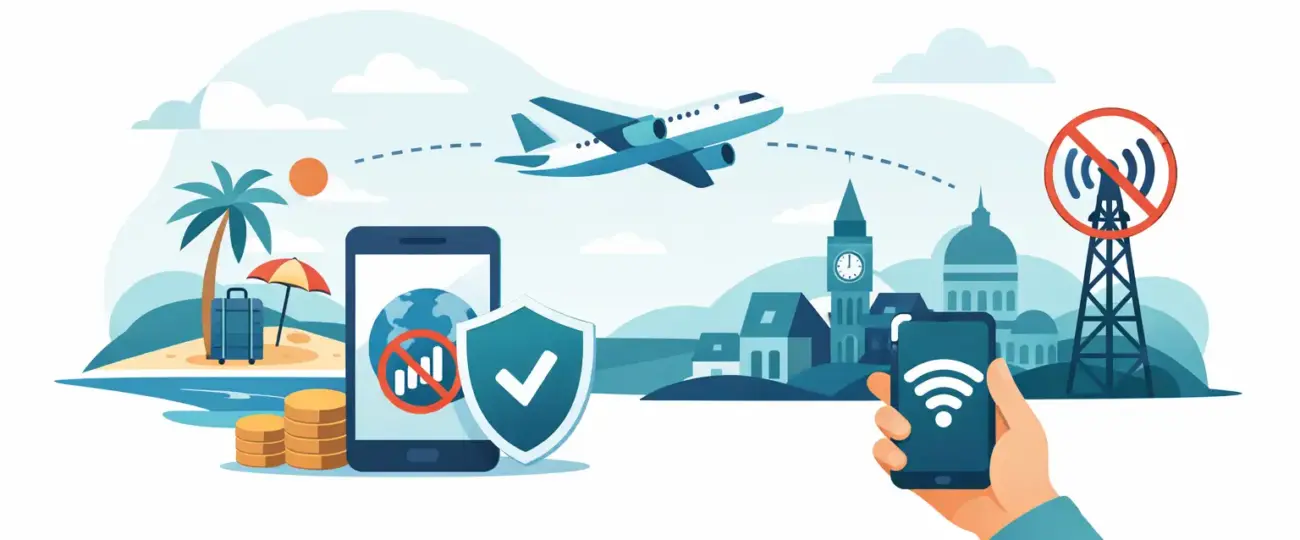


You usually find out roaming went wrong after the trip – when a few quick map checks, rideshare updates, and background app refreshes turn into a painful bill. If you are wondering איך להימנע מחיובי roaming, the good news is that it does not require technical skills. It requires a few smart settings, the right mobile plan, and a quick check before takeoff.
For most travelers, roaming charges happen for one simple reason: the phone keeps acting like it is at home. It syncs photos, updates apps, checks email, backs up files, and pulls mobile data in the background. Once your carrier connects to a partner network overseas, those small actions can become expensive fast. That is why avoiding roaming is less about one magic switch and more about controlling how your phone connects.
The cheapest time to solve roaming is before you leave. Waiting until you land usually leads to rushed decisions, bad airport Wi-Fi, and paying more for less flexibility.
Start with your current carrier. Check whether your domestic plan includes international data, daily roaming passes, or capped usage abroad. Some carriers make travel add-ons sound simple, but the cost adds up quickly on longer trips or multi-country itineraries. A plan that looks fine for a weekend can become expensive over ten days, especially if the included high-speed data is limited.
Then look at how much data you actually use. If your trip depends on navigation, messaging apps, email, hotspot use, and constant browsing, a tiny roaming allowance will not last. On the other hand, if you mostly need maps and occasional messages, you may not need an unlimited option. The right choice depends on your travel style, not just the sticker price.
This is where many travelers switch to an eSIM data plan before departure. Instead of relying on carrier roaming, you install a digital SIM on a compatible phone, activate it when you arrive, and use local or regional data rates without swapping your physical SIM. For people visiting more than one country, that can remove a lot of friction. You buy online, scan, and connect.
A common mistake is assuming that not actively browsing means not using data. Phones do a lot on their own. Cloud backup, app refresh, software updates, visual voicemail, and messaging attachments can all trigger mobile data use in the background.
Your phone may also connect at the worst possible time. Maybe you turned off Wi-Fi after leaving the hotel and forgot about it. Maybe your navigation app recalculated routes for an hour. Maybe a video started autoplaying in a social feed. None of that feels dramatic in the moment, but on a roaming network it can be enough.
There is also a difference between voice roaming, text roaming, and data roaming. Some travelers disable data roaming and assume they are fully protected, then make or receive calls abroad and still see extra charges. Others keep their primary line active for texts and forget that some carrier settings can still generate fees. The details vary by carrier, which is why checking the rules ahead of time matters.
If your goal is predictability, the safest setup is simple: decide in advance which connection you will use for data abroad and turn everything else off. That could be your carrier’s international add-on, hotel and public Wi-Fi only, a local SIM, or more commonly now, an eSIM plan.
For many travelers, eSIM is the most convenient middle ground. It is easier than finding a local store after landing, and usually more affordable than standard roaming from home carriers. It also works well for short trips, business travel, and multi-country routes because you can set it up before you leave instead of troubleshooting on arrival.
If you use an eSIM for data, make sure your phone is configured correctly. Set the eSIM as the data line. Turn off data roaming on your primary domestic line unless you specifically need it. Disable cellular data switching if your phone supports that feature, so it does not jump between lines automatically. These small settings are where many surprise charges begin or end.
Once the trip starts, the main rule is consistency. If you decided to use an eSIM or a travel data plan, stick with that setup instead of mixing networks casually.
Use Wi-Fi when it is reliable, but do not depend on it for everything. Hotel Wi-Fi can be inconsistent, airport Wi-Fi can be crowded, and public networks are not always ideal for work or banking. That is why having mobile data ready matters. The point is not to chase free internet all day. The point is to avoid accidental roaming while still staying connected when you need it.
Keep background usage under control. Turn off automatic app updates over cellular. Pause cloud photo backup until you are on trusted Wi-Fi. Review which apps can use cellular data, especially streaming, social media, and file-sharing apps. If you travel often, these settings are worth keeping in place all the time.
It also helps to download what you need before moving around. Offline maps, boarding passes, hotel confirmations, translation packs, and key documents reduce your dependence on live data. This is not about going fully offline. It is about lowering your risk when signal changes or settings fail.
If you are traveling for work, watch out for hotspot usage. Tethering a laptop can burn through data much faster than phone use alone. Video calls, cloud drives, and large attachments add up quickly. A travel data plan can still save money compared with roaming, but you need enough allowance for how you actually work.
Avoiding roaming charges does not always mean avoiding carrier roaming entirely. For very short trips, a one-day or two-day roaming pass can be perfectly reasonable. If your employer covers the cost, convenience may matter more than savings. And if your phone is not eSIM-compatible, your options may be narrower.
But there is a trade-off. Carrier roaming plans are usually built for simplicity, not value. The longer the trip or the more countries you visit, the less attractive they tend to become. That is why frequent flyers, digital nomads, and long-stay travelers often prefer a separate data solution with clearer pricing.
Another detail to consider is your phone number. Some travelers want to keep their regular number active for calls or banking texts while using a separate data line abroad. Dual SIM and eSIM setups are especially useful here, but they need to be configured carefully. If you leave the wrong line active for data or calls, you can still trigger charges.
Before departure, confirm that your device is unlocked and eSIM-compatible if you plan to use one. Install the plan while you still have stable internet. Read the activation timing so you know whether it starts on installation or on network connection at destination.
Right before takeoff, turn off data roaming on the line you do not want using mobile data. After landing, check that your phone connected to the intended network and that cellular data is assigned correctly. It takes less than a minute and can save a lot of money.
During the trip, monitor data use every day or two. Most phones show usage by line and by app. If something looks unusually high, you can catch it early instead of after the bill arrives. This is especially useful on shared family trips, where one person streaming in the back seat can affect the whole plan.
Travel connectivity should feel easy, not risky. If you plan ahead, choose the right data option, and set your phone up with intention, avoiding roaming charges is straightforward. For travelers who want the fastest path from landing to being online, solutions like eSimple Pro fit that goal well – buy, scan, and connect without the usual carrier bill shock. A few minutes before your trip can spare you a very expensive surprise after it.
 North eSIM
Price range: 1.78 € through 56.45 €
North eSIM
Price range: 1.78 € through 56.45 €
 eSim Bahrain
Price range: 1.75 € through 55.43 €
eSim Bahrain
Price range: 1.75 € through 55.43 €
 eSim Bahamas
Price range: 5.80 € through 183.93 €
eSim Bahamas
Price range: 5.80 € through 183.93 €
 eSim Azerbaijan
Price range: 1.75 € through 60.28 €
eSim Azerbaijan
Price range: 1.75 € through 60.28 €
 eSim Australia
Price range: 1.25 € through 65.98 €
eSim Australia
Price range: 1.25 € through 65.98 €
© 2026 Esimple. All rights reserved by Cubixsol

 Written by