
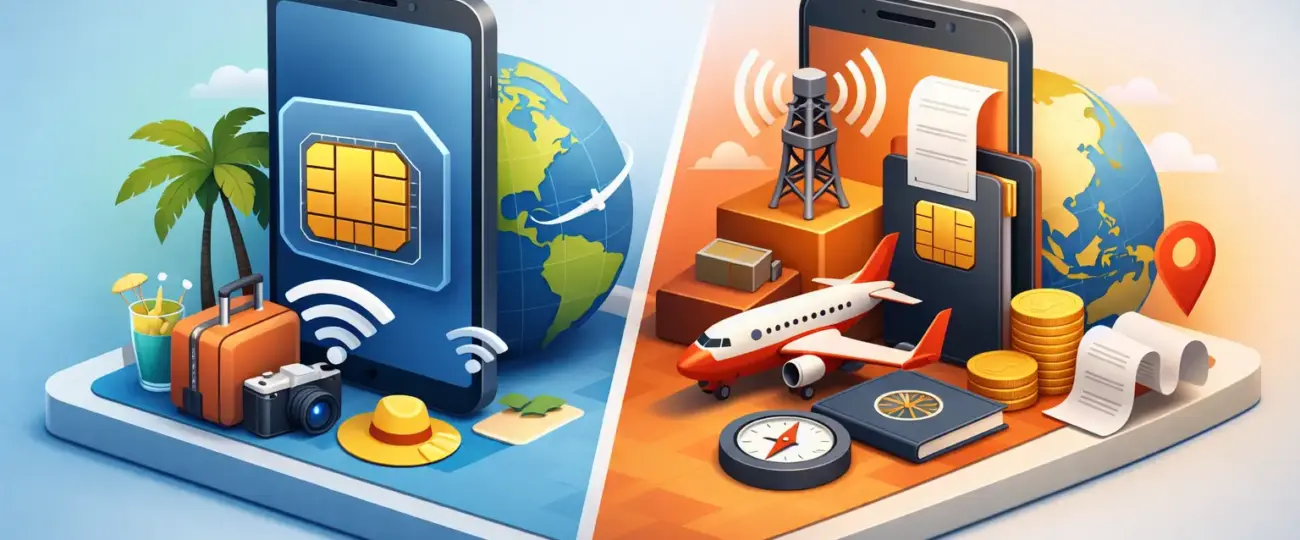


You land, turn off airplane mode, and wait for that text from your carrier warning that international roaming rates now apply. That moment is exactly why so many travelers compare esim vs roaming abroad before a trip. The right choice can mean the difference between easy, affordable data and a painful phone bill when you get home.
For most travelers, the decision comes down to convenience, cost control, and how much flexibility you need once you cross a border. Roaming is familiar because it works through your home carrier. An eSIM is newer for some people, but it gives you a digital way to add a travel data plan without removing your physical SIM. Both can keep you connected. They just do it in very different ways.
Roaming means your home mobile carrier lets your phone connect to a partner network in another country. You keep using your regular line, and charges are either billed by the day, by the MB, or through an international add-on.
An eSIM is a digital SIM built into many newer phones. Instead of relying on your home carrier’s roaming rates, you install a separate mobile plan for your destination, often before you leave. You usually buy online, scan a QR code, and activate when you arrive.
That difference matters because roaming extends your existing plan, while an eSIM gives you a separate travel plan built for international use. If you want a plug-and-go option with your usual number untouched, roaming can feel simple. If you want more control over data costs and plan options, eSIM often makes more sense.
For many travelers, roaming is the expensive default. Some US carriers offer travel passes that charge a daily fee. That can be fine for a short weekend trip, but the math changes quickly on a two-week vacation or a multi-country work trip. If your plan charges per day, you can end up paying for every calendar day you use even a small amount of data.
Traditional roaming can get even riskier when the pricing is not flat. Pay-per-use roaming rates are where bill shock still happens. Background app refresh, map usage, video calls, or photo backups can consume more data than expected.
An eSIM usually gives you a set amount of data for a fixed price. That predictability is the main appeal. You know how much data you are buying, how long it lasts, and what top-up options are available if you need more. That makes it easier to budget, especially if you travel often or across several countries.
That said, roaming is not always a bad deal. If your premium phone plan already includes generous international usage, or if you only need a small amount of data for a day or two, using your carrier’s roaming add-on may be good enough. The best option depends on how your carrier prices travel and how heavily you use data.
Roaming wins on familiarity. You do not need to install anything new if your carrier has already enabled international roaming. You land, your phone connects, and that is it. For travelers who want the least amount of pre-trip setup, that can be appealing.
But convenience is not just about doing nothing. It is also about avoiding problems later. An eSIM takes a few minutes to set up before departure, but that one step can save time once you arrive. You are not searching airport kiosks, handling tiny plastic SIM cards, or trying to understand local telecom options after a long flight.
For a lot of travelers, especially people visiting more than one country, eSIM becomes the simpler choice in practice. You can install it in advance, keep your main SIM in place, and connect as soon as you land. Services like eSimple Pro are built around that buy, scan, and connect flow, which removes much of the friction first-time users worry about.
One reason people hesitate in the esim vs roaming abroad debate is network quality. They assume roaming through a major home carrier must be more reliable. Sometimes it is. But not always.
Roaming depends on your carrier’s agreements in each destination. In one country, you might get excellent service on a strong partner network. In another, speeds may be reduced, access may be limited, or high-speed data may cap quickly.
With an eSIM, performance depends on the local networks behind the plan you buy. A well-designed travel eSIM can offer strong 4G or 5G access in many destinations, but quality still varies by region and provider. The difference is that you are often choosing a plan built specifically for travel use in that country or region, rather than accepting whatever roaming arrangement your home carrier has in place.
If reliable data matters for work, navigation, rideshare apps, or messaging, it is worth checking destination coverage details before you travel. Neither roaming nor eSIM is universally better in every country. The smarter move is to compare what is actually offered where you are going.
A common concern with eSIM is losing access to your regular number. In reality, many modern phones support dual SIM use, which means you can keep your physical SIM or primary eSIM active for calls and texts while using a travel eSIM for data.
That setup is useful if you need two things at once: affordable data abroad and continued access to your everyday number for banking codes, work calls, or personal messages. It is one of the biggest reasons eSIM has become popular with business travelers and frequent flyers.
Roaming still has the edge if you want everything to run exactly as it does at home with zero settings changes. But if your goal is to keep your number while avoiding roaming charges, dual SIM functionality gives eSIM a strong advantage.
Roaming is not outdated. It is simply less cost-efficient in many travel scenarios. There are still situations where it is the better fit.
If you are taking a very short trip, need instant access without any prep, and your carrier offers a clear daily roaming pass, staying on your existing plan may be perfectly reasonable. The same is true if your employer covers the cost, or if your unlimited plan includes international data in the places you visit.
Roaming can also be useful as a backup. Some travelers leave their home SIM available for essential texts and calls, then use another option for most of their data. That hybrid approach can work well if you want reassurance without relying fully on expensive roaming.
An eSIM tends to be the stronger option when you want predictable pricing, flexible plan sizes, and quick setup without visiting a store. It is especially practical for longer trips, data-heavy usage, and multi-country travel.
It also suits travelers who do not want to swap physical SIM cards. There is less chance of losing your home SIM, less hassle managing trays and pins, and more freedom to arrange your connectivity before you leave.
If you use maps constantly, upload travel content, work remotely, or need data the minute you land, an eSIM is often the more efficient tool. It is built around the way people travel now: moving fast, crossing borders, and expecting their phone to work immediately.
Start with your trip length. A two-day visit and a three-week itinerary are different decisions. Then look at how much data you actually use. Messaging and email require very little. Navigation, hotspot use, video, and social media uploads are another story.
Next, check whether your phone supports eSIM and dual SIM. Most newer devices do, but it is worth confirming before you buy anything. After that, compare the real total cost of your carrier’s roaming option against a destination-specific or regional eSIM plan.
Finally, think about your tolerance for setup. If spending five minutes before departure saves you money and gives you more control, eSIM is likely worth it. If you would rather pay more to keep everything exactly as it is, roaming may still be the right call.
The best travel connectivity choice is not the one that sounds most familiar. It is the one that fits how you actually move, work, and stay in touch when you are away from home. Pick the option that lets your phone help your trip instead of complicating it.
 North eSIM
Price range: 1.78 € through 56.45 €
North eSIM
Price range: 1.78 € through 56.45 €
 eSim Bahrain
Price range: 1.75 € through 55.43 €
eSim Bahrain
Price range: 1.75 € through 55.43 €
 eSim Bahamas
Price range: 5.80 € through 183.93 €
eSim Bahamas
Price range: 5.80 € through 183.93 €
 eSim Azerbaijan
Price range: 1.75 € through 60.28 €
eSim Azerbaijan
Price range: 1.75 € through 60.28 €
 eSim Australia
Price range: 1.25 € through 65.98 €
eSim Australia
Price range: 1.25 € through 65.98 €
© 2026 Esimple. All rights reserved by Cubixsol

 Written by